
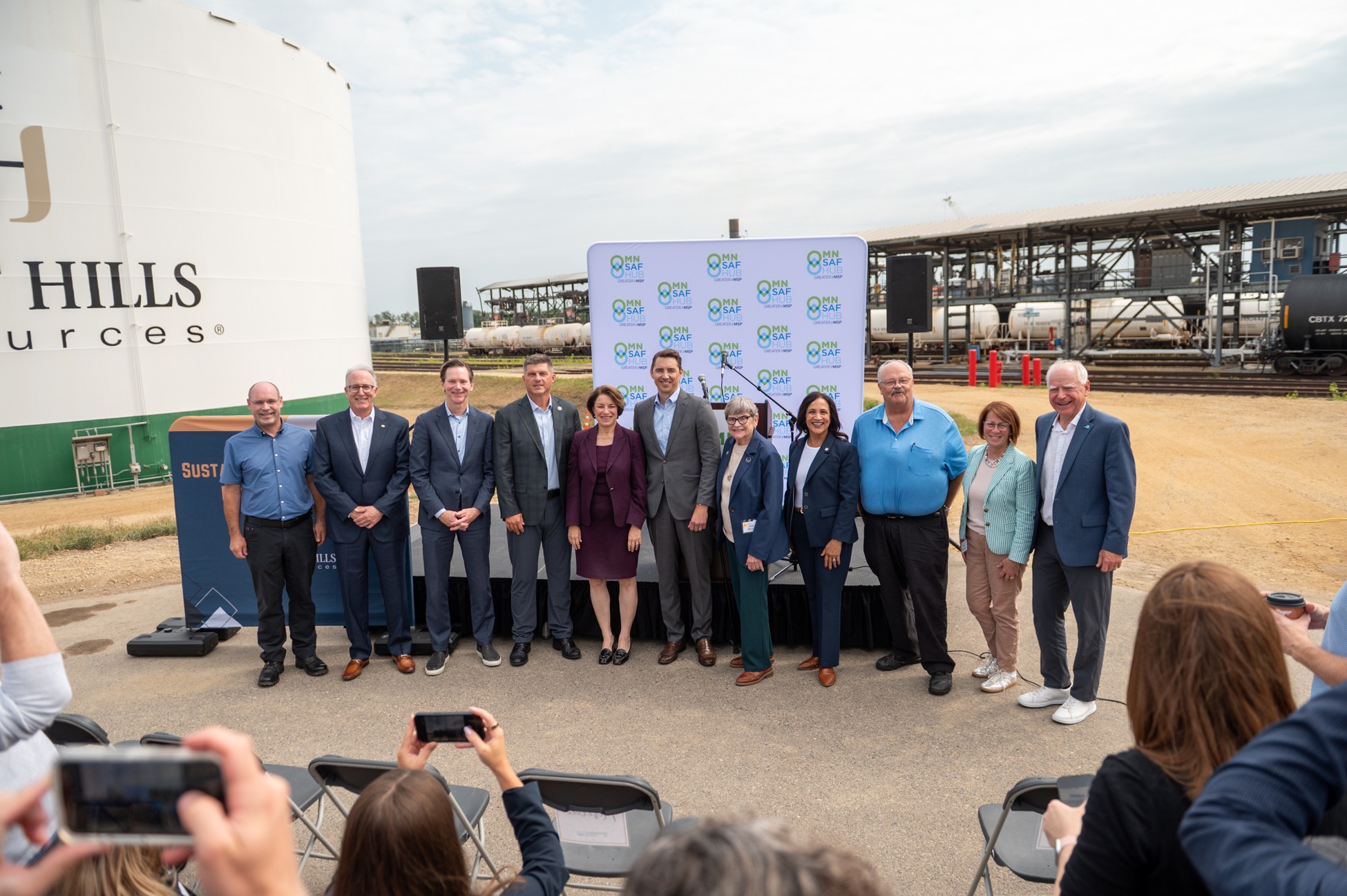
Delta has joined Minnesota leaders to mark the completion of a new sustainable aviation fuel (SAF) blending facility at Flint Hills Resources’ Pine Bend refinery. The installation is intended to increase SAF availability at Minneapolis-Saint Paul International Airport (MSP), Delta’s second-largest hub, according to the airline’s July 27, 2026 announcement.
A local blending point for MSP
The facility allows SAF to be blended locally with conventional aviation fuel before being sent directly to MSP through existing pipeline infrastructure. That creates a local blending point and a direct supply route for fuel reaching the airport, addressing part of the logistical challenge involved in making SAF available at a major hub.
Delta says it uses about 250 million gallons of aviation fuel each year at MSP. The new installation is expected to be able to blend up to 30 million gallons of unblended SAF annually. The comparison is important: even if the facility reaches that stated maximum, its annual SAF input would represent only a portion of the fuel Delta uses at the hub.
What the project can—and cannot—solve
SAF is an alternative aviation fuel made from renewable feedstocks. Delta presents it as capable of significantly reducing carbon emissions over its life cycle compared with conventional fuel. It can be used in current aircraft engines and moved through much of the fuel infrastructure already used by airports, making blending and distribution capacity important to expanding airline access.
The larger constraint remains supply. Delta’s announcement says SAF production is still limited and that progress requires investment in production, supply chains and infrastructure. The Pine Bend project strengthens the blending and delivery side of that chain, but completing the installation does not by itself remove the production limit.
That distinction also sets the scale of the immediate change at MSP. The project changes how SAF can reach the airport; it does not establish that enough SAF will be available to cover Delta’s overall fuel demand there. The amount ultimately supplied will continue to depend on wider production and distribution capacity.
Part of a broader Minnesota and Delta plan
Delta and Flint Hills Resources announced the project in September 2024. The facility is one of four milestones identified by the Minnesota SAF Hub, launched by Delta, Greater MSP Partnership, Bank of America, Ecolab and Xcel Energy.
The project also forms part of a recently announced five-year collaboration between Delta and Shell Aviation to increase SAF availability at U.S. hubs and priority cities, including MSP, through 2030. Delta says about 90% of its carbon emissions come from aviation fuel. The airline has set a target of using SAF for 10% of its fuel by 2030 and aims to reach net-zero emissions by 2050.
For passengers using MSP, the development is primarily an infrastructure change rather than a change to the airport experience described here. Its practical significance lies in adding capacity to blend and deliver SAF locally, while the broader environmental effect will depend on how quickly SAF production and supply expand beyond Pine Bend.
The completed facility is therefore a concrete step for Delta’s second-largest hub, with a clear limitation: local blending can improve access to SAF, but it cannot replace the need for sufficient SAF production.
Official sources
Primary source: Official source: news.delta.com